
.png)
Climate Action


In April 2023, Council unanimously declared a Climate Emergency, reaffirming the Town’s commitment to addressing climate change. In March 2024, Council unanimously approved the EG Thinking Green Environmental Strategy, which identifies both a Community Energy Plan and a Climate Adaptation Plan. Both plans are key deliverables for implementing the commitments established in the 2022-2026 Strategic Plan and advancing the Climate Emergency Declaration made by Council.
Watch the Climate Emergency Declaration presentation (starting at 1:23:20).
Climate Action Program
 The Climate Action Program is EG's roadmap for building a more resilient, sustainable, and prosperous community in the face of a changing climate. Developed in response to Council's Climate Emergency Declaration and guided by the Town's environmental stewardship goals, the program focuses on both reducing greenhouse gas emissions and preparing for the impacts of climate change. Through three key initiatives, the Climate Adaptation Plan, Corporate and Community Energy Plan, and Thinking Green Development Standards, the program will help protect residents from extreme weather, improve energy efficiency, support cleaner transportation, conserve natural resources, enhance biodiversity, and encourage sustainable growth. By taking practical, actionable, realistic, and trackable steps today, East Gwillimbury is investing in healthier neighbourhoods, a stronger local economy, and a safer, more resilient future for generations to come.
Watch the Climate Action Program presentation (starting at 28:30).
Community Energy Plan

EG’s population is expected to triple by 2050, making it critical to ensure that growth occurs in a sustainable, low-carbon manner. Under a business-as-usual scenario, a future in which no action is taken, emissions are projected to increase by 215% by 2050. The Community Energy Plan establishes a 2022 baseline inventory with total community emissions of 270,160 tonnes of CO₂, and per capita emissions of 7.17 tonnes of CO₂. Total energy consumption was 5.2 million GJ, representing costs of over $185 million in energy bills (gas, hydro, gasoline and diesel).
In July 2026, Mayor and Council passed East Gwillimbury’s draft Community Energy Plan, which provides a long-term roadmap to help reduce greenhouse gas emissions, improve energy efficiency, and support sustainable growth through 16 mitigation actions targeting buildings, transportation, and waste sectors. The Plan could reduce per-capita emissions by up to 91% by 2050 while helping residents save on energy costs and improving community resilience. Total emissions could fall from 270,160 tonnes of CO₂ to approximately 80,360 tonnes of CO₂ by 2050, despite a tripling of the population.
Together with the Corporate Energy Plan and preservation of EG’s natural heritage system that supports carbon sequestration, the implementation of the Community Energy Plan will help the Town achieve net-zero emissions by 2050. Net-zero means that the community reduces greenhouse gas emissions to the minimum and any remaining amount is captured by nature.
Read the full Community Energy Plan.
Climate Change Adaptation Plan
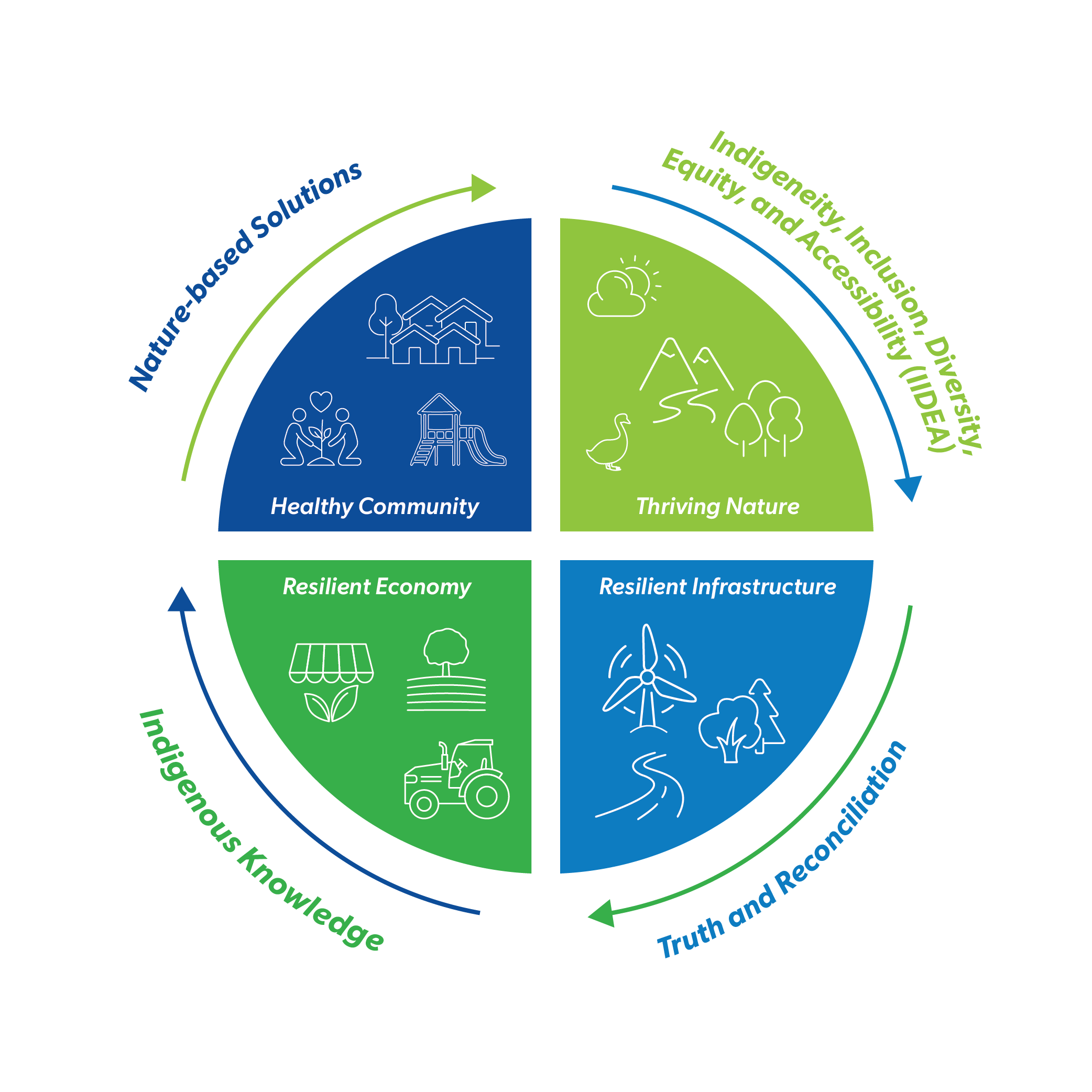
The EG’s Thinking Green Climate Adaptation Plan was developed with the participation of a Climate Adaptation Working Group made up of representatives of each Town department, Environmental Advisory Committee, Lake Simcoe Region Conservation Authority, York Region’s Climate Change team, and York Region Public Health.
The first step was to assess climate change-related risks and vulnerabilities in EG. This assessment was achieved with support of the Ontario Resource Centre for Climate Adaptation (ORCCA) Staff Capacity Program. This program aims to support adaptation efforts throughout Ontario by providing capacity and expertise. ORCCA is a pilot initiative led by ICLEI Canada (International Council for Local Environmental Initiatives) and supported by the Ontario Ministry of Environment, Conservation and Parks (MECP) alongside financial support from the Government of Canada through the federal Department of Environment and Climate Change Canada.
The EG Climate Science report and Climate Change Risk and Vulnerability Assessment report identified climate trends and projections for East Gwillimbury over short and long-term periods, along with areas of concern based on climate impact statements determined by the Climate Adaptation Working Group.
The findings were then presented to the community to share feedback and to identify adaptation opportunities and actions. To ensure climate equity and accessibility, several workshops were held with equity-owed communities including the Black community, 2SLGBTQIA+ community, youth, seniors, Georgina Island First Nation, and more. These workshops and general community feedback shaped the climate actions that were considered for the Climate Adaptation Plan.
In July 2026, Mayor and Council passed East Gwillimbury’s Climate Adaptation Plan, which outlines how the Town can support the community to prepare for the impacts of climate change and highlights partnerships and opportunities for related programs. The Plan identifies 15 practical actions to strengthen municipal infrastructure, protect natural assets, improve emergency preparedness, and reduce climate-related risks to residents and businesses. Alongside the 15 actions, 4 guiding principles were also identified to ensure that climate action is equitable, while protecting and reducing barriers for marginalized communities.
Read the full Climate Adaptation Plan.
Have you noticed changes in weather patterns? How are you adapting to the effects and impacts of Climate Change? Please share your thoughts by emailing the Environmental team.
Contact Us
Our Customer Service Team is here to help!


