
East Gwillimbury (EG's) oversees heritage matters related to the identification and conservation of heritage properties in EG. Heritage resources may include buildings, structures, landscapes, streetscapes, artifacts, and photographs.

The Town also oversees a list of registered and designated heritage properties.  A registered property has been identified to have potential heritage value and a designated property has a legal status under the Ontario Heritage Act to help protect its heritage value.

View the Register of Cultural Heritage Properties

To request removal from the Heritage Properties list, contact the Town's Heritage Planner to discuss if there is any historical or architectural value, then submit an application to the Heritage Advisory Committee.

Heritage Conservation Districts
Heritage Conservation Districts (HCDs) are a planning tool used to guide change in neighbourhoods that reflect EG’s social, cultural and architectural history. They help protect and enhance the unique character of historic areas while allowing for appropriate growth and development.

HCD designation can help protect neighbourhood character, support local tourism and cultural identity, and make properties eligible for heritage financial incentive programs. It also provides additional protection for properties from expropriation and helps ensure new development complements the existing streetscape.

An HCD Plan creates policies specific to the area that support the celebration and protection of its built heritage, provide public recognition and help foster a strong sense of place and community. An HCD does not require property owners to restore their property to its original or historic appearance. 

The nomination, study and planning of HCDs follow the policies in the Council-adopted Official Plan. HCDs are designated under Part V of the Ontario Heritage Act and protected through municipal by-laws.

Criteria to Establish an HCD

The Ontario Heritage Act requires that a minimum of 25% of the properties within the HCD area meet at least two of the criteria outlined in Ontario Regulation 9/06 in order for the area to be eligible for designation as an HCD. The criteria are as follows:

i.  The properties have design value or physical value because they are rare, unique, representative or early examples of a style, type, expression, material or construction method.

ii.  The properties have design value or physical value because they display a high degree of craftsmanship or artistic merit.

iii.  The properties have design value or physical value because they demonstrate a high degree of technical or scientific achievement.

iv.  The properties have historical value or associative value because they have a direct association with a theme, event, belief, person, activity, organization or institution that is significant to a community.

v.  The properties have historical value or associative value because they yield, or have the potential to yield, information that contributes to an understanding of a community or culture.

vi.  The properties have historical value or associative value because they demonstrate or reflect the work or ideas of an architect, artist, builder, designer or theorist who is significant to a community.

vii.  The properties have contextual value because they define, maintain or support the character of the district.

viii.  The properties have contextual value because they are physically, functionally, visually or historically linked to each other.

ix.  The properties have contextual value because they are defined by, planned around or are themselves a landmark.

At this stage in the process, the Town’s heritage consultants (TMHC & LHC) have reviewed all properties within the study area and have determined that more than 25% of the properties in the study area meet two or more the above listed criteria and therefore the proposed HCD area is eligible for designation as an HCD.

HCD Impact to Homeowners

The HCD Plan and Guidelines will provide direction on changes to properties within the Heritage Conservation District. Some projects may require a heritage permit from Municipal Council. The HCD Plan will identify which types of changes require a permit.

Routine property maintenance generally does not require a heritage permit. Interior renovations and alterations are also exempt under the Ontario Heritage Act. However, demolishing or constructing a new building or addition will require a heritage permit.

If a heritage permit is required, it must be obtained before a building permit can be issued. Property owners are encouraged to contact Planning early to understand the requirements and help avoid delays.

A HCD designation will not affect your property taxes. For property insurance, the age of a building is typically considered when calculating insurance premiums, rather than whether the property is designated as heritage.

Studies across Ontario and other jurisdictions have generally found that properties within Heritage Conservation Districts tend to maintain or increase in value compared to similar properties outside of designated areas. HCD designation can contribute to neighbourhood stability, consistent streetscape character, and the appeal of the area to prospective buyers.

Some properties within the HCD are classified as "non-contributing", meaning they are within the boundaries of the HCD but are not considered to have heritage significance.

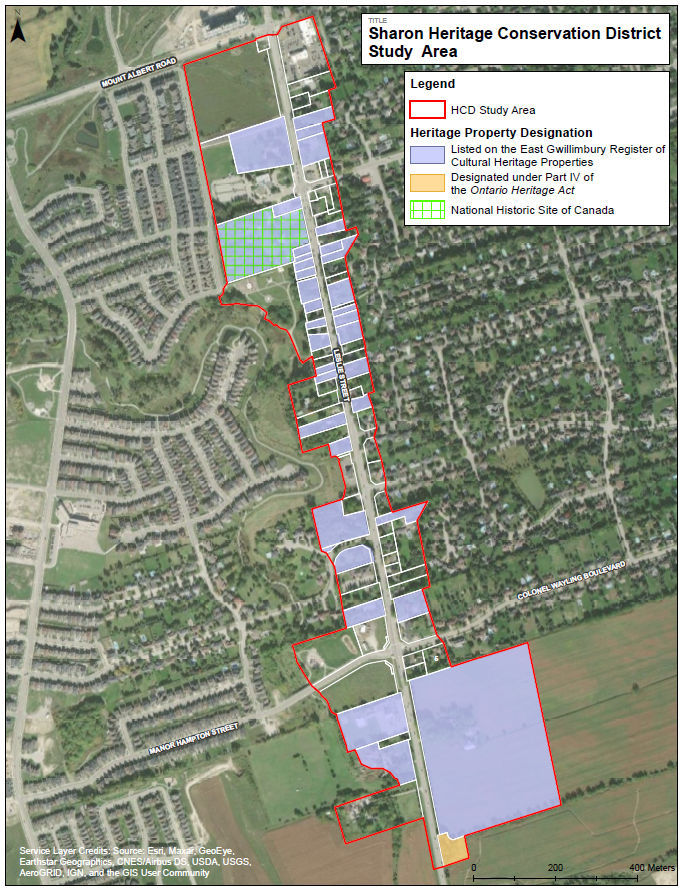
Sharon Heritage Conservation District Map of Sharon HCD study area

In May 2026, Council adopted the Sharon Heritage Conservation District (HCD) Plan and Guidelines. The plan and guidelines will help guide growth and development of the Heritage Conservation District and protect the heritage attributes of Sharon Village.

Sharon Heritage Conservation District Plan and Guidelines

For information on previous public consultations, reports, and memos, please contact Planning.

Built Heritage Strategy

The Build Heritage Strategy (adopted in December 2025) will help guide how we identify, preserve, and celebrate cultural heritage across the community. Before the Built Heritage Strategy, EG had undertaken various heritage preservation initiatives, but did not have a single, comprehensive strategy outlining heritage goals and priorities for the Town as a whole. The strategy identified long-term goals and specific priorities such as:

  • Engaged the public and identified priorities
  • Developed policy recommendations
  • Recommended programs and resources

View the Built Heritage Strategy

Heritage Advisory Committee

The Heritage Advisory Committee (HAC) makes recommendations to Council on all matters relating to the conservation of buildings of historic or architectural value. Planning staff work with the Heritage Advisory Committee (HAC) to promote heritage conservation through the protection of heritage sites and implementing policies to guide changes in the area.

Heritage Resources