

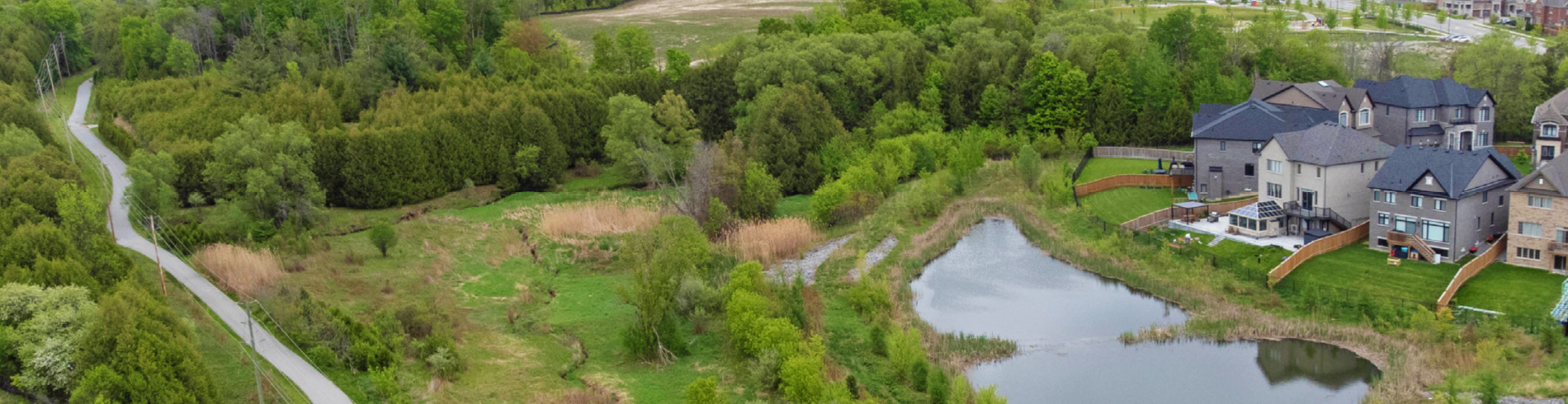
Stormwater Management


In developed areas, where driveways, buildings and roads cover soil, water cannot be absorbed and instead travels over these paved and hard surfaces as runoff. As it flows over these surfaces, the runoff collects various pollutants (dirt, fertilizer containing phosphorus and nitrogen) and debris (grass-clippings, paper, cigarette butts).
Stormwater Management Ponds (SWMPs) are engineered and naturalized facilities designed to collect runoff from the local storm sewer system following rainfall, snowmelt, or activities such as watering lawns and washing cars. SWMPs are built to temporarily hold this water, provide partial treatment to reduce pollutants, and then slowly release the stormwater back to our waterways.
SWMPs help reduce local flooding
Without SWMPs, runoff would flow quickly into watercourses in larger volumes, increasing the risk of flooding and causing erosion along stream banks. The pond’s outlet drains water from the pond into a nearby watercourse at a controlled rate.
SWMPs improve water quality
How do SWMPs work?
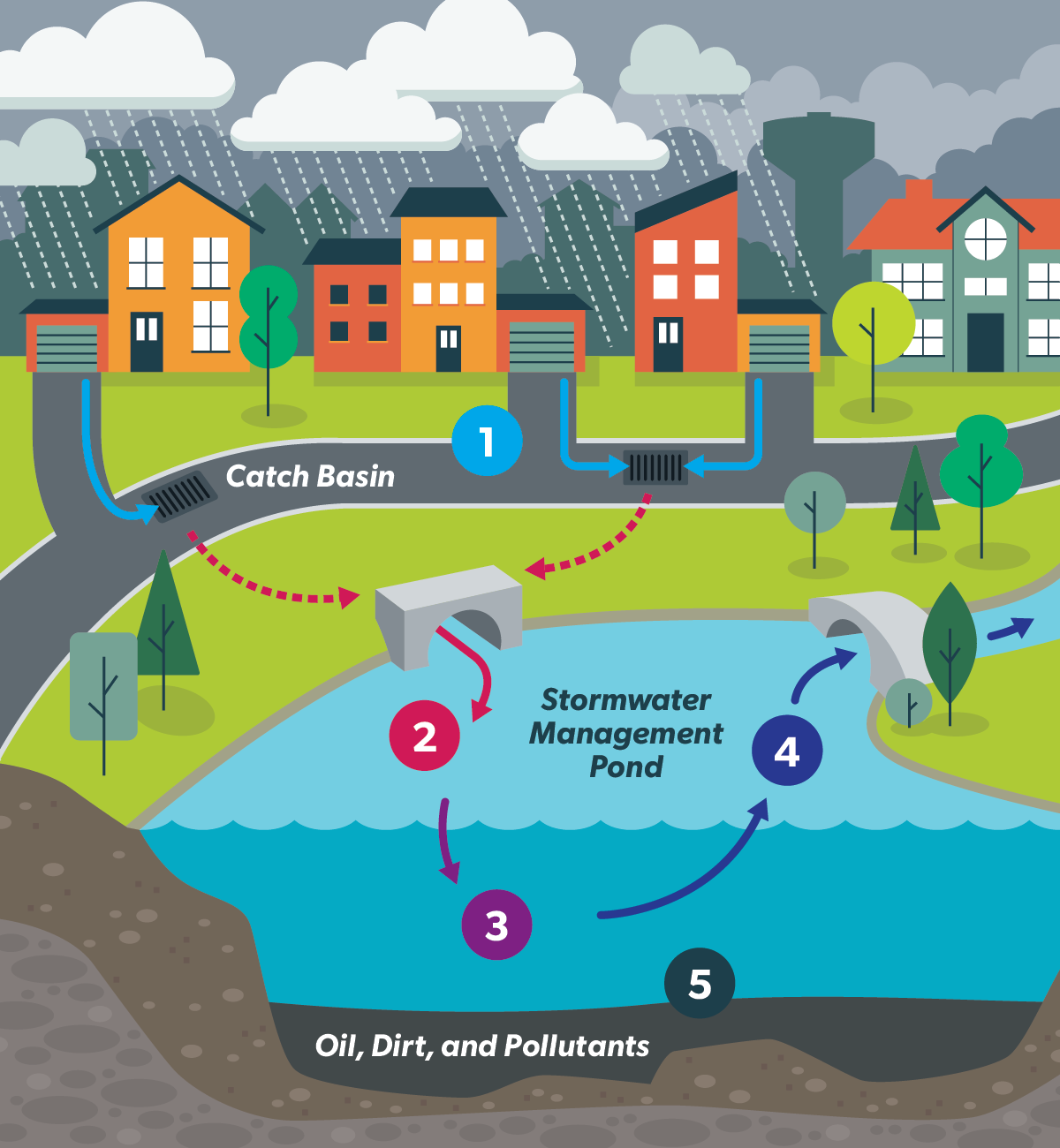
- Rain and snowmelt on surfaces like roads, driveways, and sidewalks flow into a catch basin.
- The mixture of rainwater and pollutants flows from catch basins to storm sewers that lead to stormwater management ponds.
- As the pond fills, dirt, sediment, and pollutants settle down to the bottom.
- Treated stormwater from the pond is then slowly released into local waterways.
- The Town monitors sediment accumulation and performs sediment removal when necessary to ensure the storm pond is functioning.
How are SWMPs maintained?
Maintenance includes removal of debris and maintenance of structures (i.e. gates, locks, valves, etc.). The vegetation planted around the pond is dense and appropriate for the area. Grass cutting is not required for the ponds to maintain a natural filtering environment.
A clean-out of the SWMP may be required on occasion to remove the accumulated sediment to ensure the pond continues to function.
Drainage of the SWMP will be required to facilitate the clean-out. Part of this clean-out involves soil sampling and testing to ensure proper sediment disposal..
Safety Around the Pond
SWMPs are not designed or intended for recreational use. For the health and safety of the public, several activities are prohibited, including: swimming or wading, skating, boating, and fishing.
Safety/warning signs are placed at each SWMP to inform the community of prohibited activities. These signs also highlight the potential for rapid water level fluctuations in the pond.
How to support the function of a SWMP?
- Dispose of trash, grass clippings, and yard waste responsibly
- Minimize the use of fertilizer
- Avoid disturbing vegetated areas around the pond
- Avoid discharging swimming pools or hot tubs into the pond or storm sewers
- Do not dispose of toxic substances (oil, paint, antifreeze, etc.) down storm sewers
- Report evidence of beaver activity (damming) to the Town*
- Do not release pets, fish, or wildlife into SWMPs, or plant trees or vegetation within the SWMP area
- Follow all signs posted around the ponds and report any unauthorized activities to the Town*
*Concerns can be reported to Customer Service by email or calling 905-478-4282.
Contact Us
Our Customer Service Team is here to help!


